
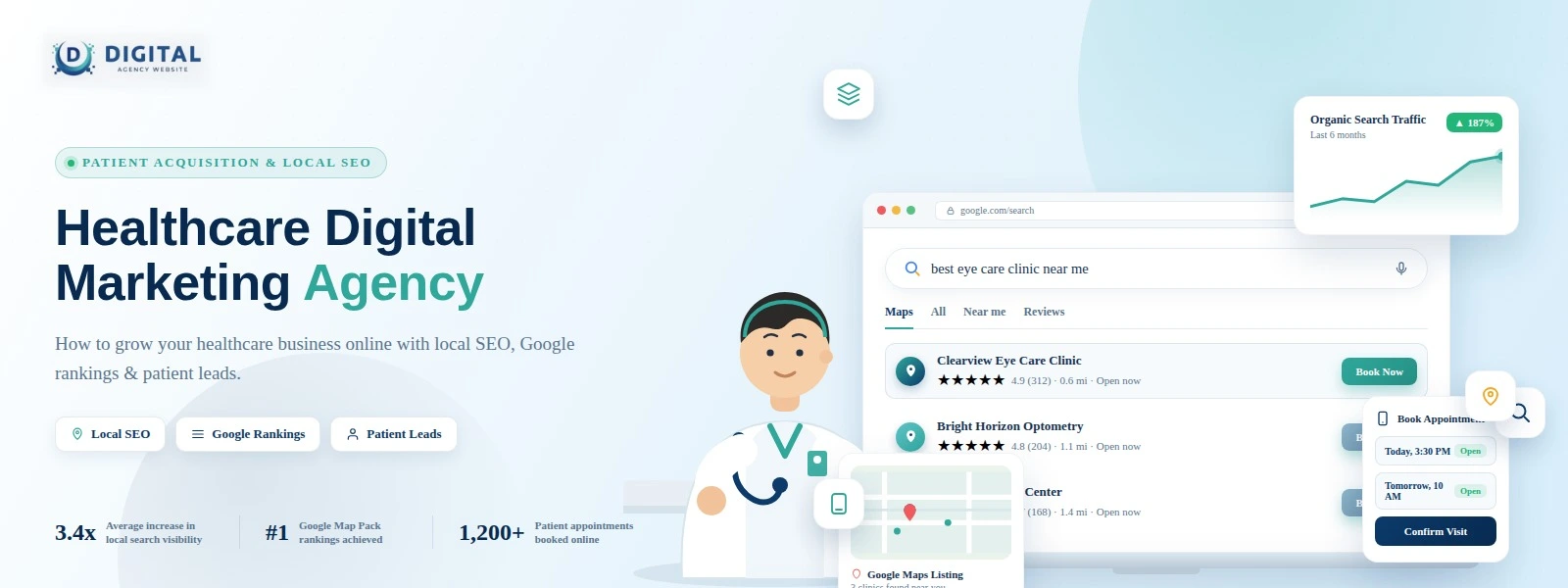
Healthcare Digital Marketing Agency: How to Grow Your Healthcare Business Online
Think about the last time you needed a doctor. Did you ask a neighbour, or did you open Google first?
Most people search now. Before they call a clinic, book a diagnostic test, or walk into a hospital, they check reviews, look at the website, and compare a few options. Sometimes they do this in five minutes on their phone while sitting in traffic.
So if your clinic or hospital has a website but nobody’s finding it, that’s a real problem. A website alone doesn’t do much. It has to actually show up when someone searches, and it has to say something useful once they land on it.
This is basically what a healthcare digital marketing agency does. It helps your practice get seen by the right people, at the right time, with information they can trust. In this post, we’ll walk through what that actually involves — not in vague marketing terms, but in a way that makes sense if you run a clinic, manage a hospital’s marketing, or just want to understand where to start.
Why Healthcare Businesses Need Digital Marketing
Here’s something worth noticing: nobody searches for “a hospital.” They search for “cardiologist near me open today” or “best paediatric clinic in delhi for infants.” The searches are specific. The intent is usually urgent or personal.
That changes how you need to think about marketing.
A few things that matter here:
- People compare more than one provider before deciding. It's rare that someone books the very first result they see.
- Reviews carry real weight. A clinic with four stars and thirty reviews often gets picked over one with no reviews at all, even if the second one is just as good.
- A confusing or outdated website makes people hesitate. And hesitation, in healthcare, often means they just try the next option.
- Consistency matters more than a single big campaign. Being visible and reliable over months builds more trust than one flashy ad.
Healthcare is different from selling shoes or software. When someone is choosing a doctor, they’re not just picking a service. They’re deciding who to trust with something personal. That’s why healthcare marketing has to be handled a bit more carefully than other industries.
What Does a Healthcare Digital Marketing Agency Actually Do?
| Digital Marketing Strategy | Description |
|---|---|
| Strategy | Figuring out who your ideal patients are and what they actually search for. |
| SEO | Making your website show up when people search for your services. We provide top Search Engine Optimization Services to improve your online visibility and rankings. |
| Content | Writing pages, blogs, and FAQs that answer real patient questions in plain, easy-to-understand language. |
| Paid Advertising | Running search or social media ads so your practice appears faster, especially for competitive services. |
| Social Media | Maintaining an active presence where patients already spend their time online. |
| Website Optimization | Ensuring your website loads quickly, works seamlessly on mobile devices, and provides a user-friendly experience. |
| Local SEO | Helping your practice appear in Google Maps and "near me" search results to attract local patients. |
| Reputation Management | Monitoring online reviews and responding professionally to build trust and credibility. |
| Reporting | Tracking what is actually working with real data instead of relying on assumptions. |
| Conclusion: None of this is about tricks or shortcuts. It's about being clear, consistent, and easy to find online. When done properly and consistently over time, these strategies help build trust, improve visibility, and attract more patients. | |
Healthcare Digital Marketing Services That Actually Move the Needle
| Service | What It Does | How It Helps |
|---|---|---|
| Healthcare SEO | Gets your website ranking for relevant searches | Patients find you when they're actively looking |
| Local SEO | Improves your Google Business Profile and local listings | You show up for "near me" and city-based searches |
| Content marketing | Creates helpful pages, blogs, and FAQs | Builds trust before the patient even calls |
| Google Ads | Runs paid search campaigns | Faster visibility, especially for competitive keywords |
| Social media | Keeps an active presence on Instagram, Facebook, etc. | Keeps your practice visible between appointments |
| Website optimisation | Improves speed, structure, and usability | Fewer people leave without booking or calling |
| Reputation management | Monitors and responds to reviews | Builds confidence for people still deciding |
| Email marketing | Sends relevant reminders and updates | Keeps existing patients engaged |
| Conversion optimisation | Improves how visitors turn into enquiries | Gets more value from traffic you already have |
| Analytics | Tracks calls, bookings, and form fills | Shows what's actually working |
| Note: A small clinic might just need a better Google Business Profile and a cleaner website. A hospital with five locations probably needs a fuller mix, including ads and dedicated pages for each branch. | ||
How Healthcare SEO Helps Patients Actually Find You
SEO sounds technical, but the idea is simple: match what your website says with what people are typing into Google.
Someone searching “root canal cost near me” has a specific need. If your website has a clear page about root canals, with useful information and your location, you have a real shot at showing up. If your only mention of root canals is buried in one paragraph on a generic “services” page, you probably won’t.
A few things that help here:
-
Separate pages for each major service Not one page trying to cover everything, but individual pages for things like dental implants, cardiac consultations, or full-body checkups.
-
Pages for each location If you have more than one branch, with the correct address, hours, and services for that specific spot.
-
A complete, updated Google Business Profile This is often the first thing people see, even before your website.
-
A site that actually works wellLoads fast, works on a phone, doesn't have broken links.
-
Content that answers real questions Written the way a person would explain it to a friend, not in dense medical language.
Say a diagnostic centre offers home sample collection. A dedicated page explaining who it’s for, how it works, and how to book it will do far more for search visibility (and for actual bookings) than a one-line mention buried somewhere else.
Content That Builds Trust Before Anyone Picks Up the Phone
Most patients research before they contact anyone. They read about symptoms, look up treatments, and try to understand what they’re dealing with before booking an appointment.
Good content meets people at that stage. It can include:
- Service pages that explain what a treatment actually involves, honestly, without overselling the outcome.
- FAQs that cover the questions patients ask most — prep instructions, what to expect, how long something takes.
- Blog posts that explain general health topics simply, without jargon.
- Doctor profiles that show real qualifications and experience.
- Location pages that help people in a specific area know what's available nearby.
The one rule that matters most here: accuracy. Content should never replace a doctor’s advice, and it should never promise a specific outcome. A page explaining what happens during a routine eye exam is genuinely useful. A page claiming a treatment “guarantees results” is not just poor marketing — it’s misleading, and it can hurt patients who take it at face value.
Good healthcare content answers questions honestly and tells people clearly when they need to talk to an actual doctor instead of relying on a webpage.
Paid Advertising for Healthcare Businesses
Ads can get you in front of people right when they’re searching, which is useful, especially if you’re newer or in a competitive area where SEO alone would take too long.
Search ads show up when someone types something like “urgent care open now.” Social ads can build awareness among people in your service area, even before they’re actively searching.
A few things that make paid campaigns actually work:
- Matching ads to real search intent, not broad or loosely related terms.
- Targeting the right location and audience, not just "anyone who might be interested.
- Sending people to a landing page that matches what the ad promised.
- Keeping the ad copy honest, without inflated claims.
- Watching the budget and adjusting based on what's converting.
- Tracking whether clicks actually turn into calls or bookings, not just traffic.
One honest caveat here: ads can improve visibility, but they can’t promise a fixed number of new patients. Results depend on your location, competition, and how well your website converts the people who click through.
It’s also worth knowing that healthcare ads have to follow platform rules and, depending on where you’re based, relevant advertising regulations — especially around medical claims and patient testimonials. A good agency accounts for this from day one instead of treating your ads like they’re selling a regular product.
Why Local SEO Matters So Much for Clinics and Hospitals
Almost every healthcare search has a local angle. Nobody searches for “the best neurologist in the world.” They search for one they can actually get to.
Local SEO is what makes sure you show up in those searches. It includes:
- Keeping your Google Business Profile accurate — hours, services, phone number, all correct.
- Encouraging genuine reviews and responding to them, good or bad.
- Making sure your name, address, and phone number match exactly across your website and every directory listing.
- Having a separate page for each location, rather than lumping several branches onto one page.
- Using local terms naturally in your content, without forcing city names into every sentence.
- Showing up correctly on Google Maps
For a single clinic, this might just mean keeping your profile updated and asking happy patients to leave a review. For a hospital chain, it means building out proper pages and consistent listings for every single branch, so people in each city can actually find the right one.
How to Choose the Right Healthcare Marketing Agency
This part matters more than people think, because healthcare marketing carries more responsibility than most other industries.
What to look for:
- Real experience with healthcare clients, not just marketing experience in general.
- A clear understanding of patient privacy and healthcare advertising rules.
- SEO work you can actually verify, not just promises.
- Content that's accurate and doesn't oversell.
- Reporting that shows real numbers, not vague summaries.
- Honest communication, including about what won't work.
- No guarantees about rankings, leads, or patient numbers — because nobody can honestly promise that.
Questions worth asking before you sign anything:
- Have you worked with a business like mine before?
- How do you handle sensitive patient information in campaigns?
- What does your reporting actually look like — can I see a sample?
- How do you make sure content is medically accurate?
- What's a realistic timeline, and why?
Healthcare Marketing vs. General Marketing — What's Actually Different
| Area | General Marketing | Healthcare Marketing |
|---|---|---|
| Audience | Broad, often interest-based | People making decisions about their health |
| Trust | Important | Critical — it affects real decisions |
| Content | Focused on engagement | Must be accurate and never misleading |
| Privacy | Standard practices | Higher sensitivity around personal health data |
| Advertising rules | Fewer restrictions | Subject to healthcare-specific regulations |
| Patient journey | Often short and transactional | Often longer, involves research and reassurance |
| Reputation | Helps brand image | Directly tied to whether people trust you with their health |
| Note: This is why a marketing company that only knows retail or e-commerce often struggles with healthcare. It's not that the tools are different. It's that the stakes are. | ||
Building a Complete Growth Strategy: What the Process Actually Looks Like
- Understand the practice — what you offer, what makes you different, where the gaps are.
- Research who your patients actually are and what they search for.
- Look at what competitors nearby are doing well (and where they're falling short).
- Review your current website honestly.
- Find the specific searches worth targeting.
- Plan out content — service pages, blogs, FAQs.
- Improve local visibility across listings and Google.
- Run paid campaigns where they make sense.
- Track the numbers that actually matter — calls, bookings, form fills.
- Adjust based on what the data shows, not what the original plan assumed.
How Long Does This Actually Take to Work?
Honestly? It depends. Anyone who gives you an exact number of weeks and guarantees results is probably not being straight with you.
A few things that affect the timeline:
- How much competition exists in your area.
- Your location — a bigger city usually means more competition.
- The condition of your website right now.
- Whether you already have some online presence, or you're starting from scratch.
- Your budget
- How niche or common your services are.
- Whether your marketing is consistent or sporadic.
As a rough guide: paid ads can start showing visibility within days, since they go live almost immediately. SEO takes longer — usually a few months of steady work before you see real movement, and it keeps building after that. Neither can promise you an exact ranking or a set number of new patients. What a solid strategy can offer is steady, visible progress you can actually track.
Mistakes That Trip Up a Lot of Healthcare Businesses
A few patterns show up again and again:
- Skipping local SEO, even though most healthcare searches are local.
- Website content that's vague or hard to follow.
- Publishing information that isn't accurate.
- Content that reads like it was copied from somewhere else.
- Ignoring reviews instead of responding to them.
- Targeting people who were never going to need the service.
- Chasing traffic numbers instead of actual bookings.
- Not tracking conversions at all.
- Making promises that sound too good to be true.
- Overlooking patient privacy or platform advertising rules.
Final Thoughts
Choosing a doctor or hospital isn’t a small decision, and for most people, it starts with a search, not a phone call. A healthcare digital marketing agency’s job is to make sure your practice shows up at that moment, with information people can actually trust. At digitalagencywebsite, we understand the importance of building a trustworthy online presence for healthcare practices.
There’s no shortcut here — no agency can honestly guarantee a specific ranking or a fixed number of new patients. What actually works is being consistent: clear content, a well-built local presence, and advertising that doesn’t overpromise. It builds slowly, but it holds up. digitalagencywebsite focuses on sustainable digital marketing strategies that help healthcare practices build long-term online visibility.
If you’re wondering where your own online presence stands, that’s a good place to start — take an honest look at your website, your local listings, and the reviews people are leaving, and decide what growth realistically looks like for your practice. digitalagencywebsite can help you evaluate your current digital presence and identify realistic opportunities for growth.
Not Sure Which SEO Plan Fits?
Get a free, no-obligation SEO audit. We'll show you where you're losing visibility and recommend the right strategy to accelerate growth.